Discovering mold inside your home triggers an immediate sense of urgency. Beyond the cosmetic damage and musty odor, lingering spores degrade indoor air quality and threaten structural framing. For homeowners across Union County, the most pressing question after finding an infestation is simple: How long does professional mold remediation take? On average, a standard professional mold remediation project takes between 1 to 5 business days. However, this timeframe is not a static guarantee. A localized bathroom outbreak can wrap up in an afternoon, while a flood-damaged colonial basement in Cranford or an older home in Plainfield might require up to two weeks of controlled containment, mechanical cleaning, and structural drying. Understanding the full scope of remediation helps you plan work schedules, arrange temporary living spaces if necessary, and ensure the work adheres to strict safety protocols.
The Quick Answer: Average Mold Removal Timelines by Scope
The overall timeline depends primarily on the square footage affected and how deeply fungal roots have invaded porous construction materials.
| Severity Level | Scope of Infestation | Typical Duration | Major Work Included |
| Level 1: Minor | Under 10 sq. ft. (isolated under-sink leak, small drywall patch) | 1 – 2 Days | Surface cleaning, HEPA vacuuming, localized spot containment |
| Level 2: Moderate | 10 – 100 sq. ft. (single bathroom, small crawl space, water-damaged ceiling) | 2 – 4 Days | Full-room negative air containment, drywall tear-out, antimicrobial wash |
| Level 3: Extensive | Over 100 sq. ft. (entire basement, interconnected living spaces, attic) | 5 – 7 Days | Negative air setup, subfloor stripping, industrial dehumidification, duct sanitization |
| Level 4: Severe / Flood | Multi-level structural saturation or widespread black mold (Stachybotrys) | 1 – 2+ Weeks | Extensive demolition, prolonged deep drying, hazardous waste disposal, clearance testing |
Step-by-Step Breakdown of the Professional Mold Remediation Process
Professional remediation is governed by rigorous industry guidelines, such as the ANSI/IICRC S520 Standard for Professional Mold Remediation. Reliable technicians do not simply spray a chemical and walk away; they follow a systematic, multi-phase operational plan.
Step 1: Inspection, Moisture Mapping & Lab Testing (Day 1)
Before any physical removal begins, certified inspectors conduct visual assessments, infrared thermal imaging, and moisture mapping to locate hidden pockets of water inside walls. If toxic strains are suspected, air and tape samples are dispatched to an accredited laboratory for spore-count verification, which can take 24 to 48 hours for definitive analysis.
Step 2: Containment Setup & Air Scrubbing (Day 1–2)
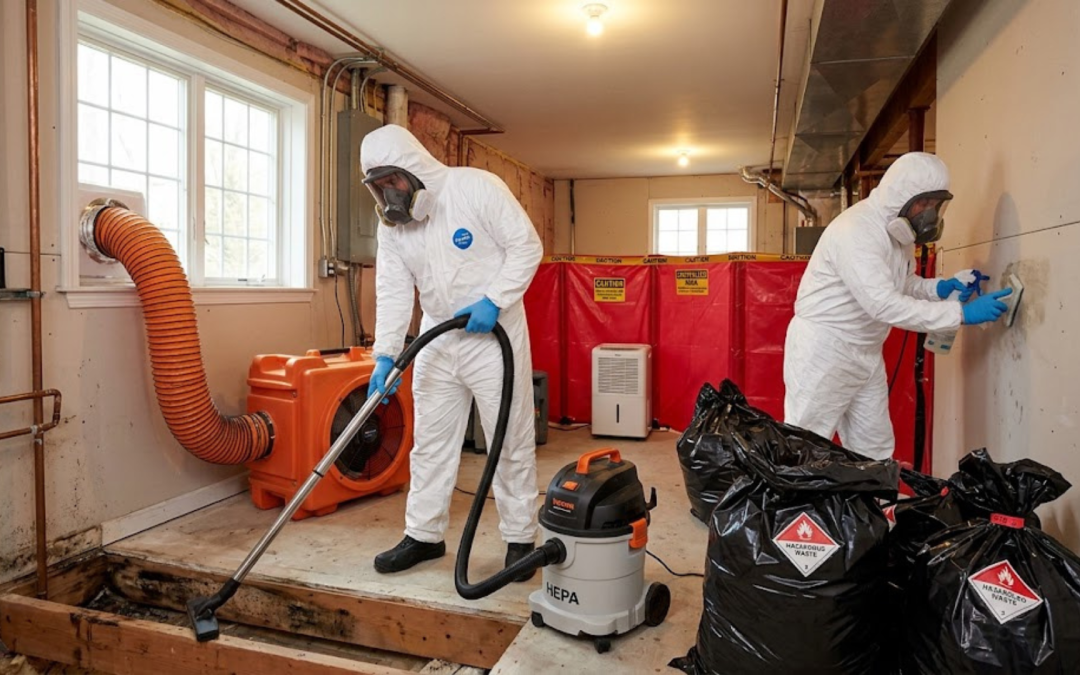
Preventing cross-contamination is critical. Before removing a single strip of baseboard, crews isolate the affected zone:
-
Sealing off doors, windows, and HVAC registers with 6-mil polyethylene sheeting.
-
Installing continuous commercial air scrubbers fitted with HEPA filters to pull microscopic spores from ambient air.
-
Establishing negative air pressure systems to exhaust contaminated air outside the living quarters.
Step 3: Material Demolition & Antimicrobial Cleaning (Day 2–3)
Non-salvageable, porous building materials—such as saturated insulation, mold-rotted drywall, and spongy carpeting—are double-bagged inside the containment zone and hauled away. Technicians then hand-scrub structural framing, subfloors, and concrete block using EPA-registered biocides and mechanical wire brushing.
Step 4: Industrial Drying & Dehumidification (Day 3–4)
Applying antifungal treatments to wet wood is ineffective. Contractors deploy high-velocity air movers and commercial desiccant or LGR (low-grain refrigerant) dehumidifiers. Structural timber must reach a dry standard—typically below 16% wood moisture equivalent (WME)—before containment barriers can safely be taken down.
Step 5: Post-Remediation Verification (Clearance Testing) (Day 4–5)
-
An independent third-party environmental inspector reviews the work area while containment remains intact.
-
Comparative indoor and outdoor air sampling verifies that airborne spore counts have returned to normal, background ecology levels.
-
Once the laboratory issues a formal Certificate of Clearance, containment equipment is dismantled.
6 Key Factors That Speed Up or Delay Your Remediation Timeline
-
Accessibility of the Work Area: Unobstructed rooms move quickly. Cramped crawlspaces, blown-in attic rafters, or spaces behind tiled tub surrounds demand careful labor that extends completion schedules.
-
Material Porosity: Solid wood studs, glass, and ceramic tiles can be sanitized directly. Drywall, cellulose insulation, and wall-to-wall carpeting must be systematically dismantled and discarded.
-
Resolution of the Moisture Source: If remediation begins while a roof valley leak or foundation crack remains unresolved, work must pause until active water intrusion stops.
-
HVAC System Infiltration: If mold has colonized the central heating and air conditioning unit or supply trunks, the entire mechanical system requires specialized vacuuming and decontamination.
-
Mold Species Identified: Dense colonies of toxic black mold (Stachybotrys chartarum) demand elevated PPE protocols, specialized disposal handling, and longer containment runs.
-
Insurance Adjuster Coordination: When filing a homeowner’s insurance claim, awaiting on-site adjuster approvals or supplemental damage reviews can pause work mid-stream.
Why Union County Homes Face Unique Mold Remediation Timelines
Residential properties throughout Union County contend with distinctive environmental pressures that often prolong drying and remediation periods.
In municipalities like Cranford, Rahway, and Union, homes situated near the Rahway River watershed frequently battle elevated water tables, flash flooding, and continuous hydrostatic pressure against subterranean basement walls. In contrast, historic housing stock in Summit, Westfield, and Plainfield regularly features century-old stone or rubble foundations, older lath-and-plaster walls, and retrofitted ductwork. Plaster holds trapped moisture significantly longer than modern drywall, and porous fieldstone requires aggressive, extended dehumidification to fully dry before sealants can adhere properly.
Mold Remediation vs. Restoration: Understanding the Real Finish Date
Homeowners often confuse remediation with total reconstruction.
-
Remediation (Days 1–5): The process of identifying the water leak, isolating the room, demolishing contaminated materials, sanitizing structural framing, and purifying the air. At the end of remediation, your room is clean, safe, and mold-free, but it will often be stripped down to bare framing studs and concrete subfloors.
-
Restoration (Days 6–14+): The subsequent construction phase. This entails hanging and finishing fresh drywall, installing insulation, laying down new flooring, painting, and reinstalling trim. Factoring in both steps prevents misunderstandings regarding when your living space will be fully restored.
Can You Live in Your House During Mold Remediation?
-
When staying is fine: The mold is isolated to an unused basement, detached garage, or guest bathroom, and technicians maintain effective negative air pressure containment throughout the job.
-
When you should temporarily vacate: The central HVAC system is contaminated, the master bathroom or kitchen is the target area, or active demolition covers more than 100 square feet.
-
Health-sensitive individuals: Infants, elderly family members, and individuals diagnosed with chronic asthma or compromised immune systems should always leave the premises until final clearance tests pass.
-
Noise and environment: High-powered air scrubbers and industrial dehumidifiers run continuously day and night, generating substantial ambient heat and mechanical hum.
Red Flags That Indicate a Contractor Is Rushing the Process
-
Offering a complete whole-house remediation in under four hours using only “fogging” sprays.
-
Painting over visible mold colonies with standard primer without prior sanitization or physical removal.
-
Skipping the use of sealed containment barriers and HEPA-filtered air scrubbers.
-
Resisting third-party post-remediation clearance testing (PRV) or claiming self-testing is sufficient.
Tips for Union County Homeowners to Prevent Mold from Returning
-
Maintain whole-home indoor relative humidity levels between 30% and 50% using dedicated, continuous dehumidifiers.
-
Route gutter downspout extensions at least 6 to 10 feet away from exterior foundation footings.
-
Test and service your sump pump system and battery backup before seasonal spring thaws and heavy North Jersey storms.
-
Verify that bathroom, kitchen, and clothes dryer exhaust vents discharge directly outside rather than into attic insulation.