Cranford, New Jersey, affectionately known as the “Venice of New Jersey,” is renowned for its picturesque waterways, mature tree-lined streets, and historic charm. However, the very features that lend the township its unique character also create an environment uniquely susceptible to indoor moisture problems. Mold spores exist naturally everywhere in the ambient air, but when given warmth, organic building materials, and persistent moisture, they settle, germinate, and form aggressive colonies inside living spaces.
For homeowners in Cranford, understanding the specific environmental, architectural, and mechanical triggers of mold growth is the first defense against property damage and chronic indoor air quality issues. Whether dealing with seasonal dampness, structural quirks of historic construction, or sudden water intrusion, mold removal in Cranford begins with recognizing why and where dampness takes hold.
The Cranford Environment: Why Local Homes Are Prime Targets for Mold
Indoor fungal growth is never an isolated biological event; it is always the direct outcome of an unmanaged moisture source. In Union County, the regional climate plays a major contributing role. Cranford experiences hot, humid summers where outdoor relative humidity frequently exceeds 70 to 80 percent, coupled with cold winters and heavy, storm-driven shoulder seasons.
Furthermore, Cranford’s geographical position within the low-lying Rahway River drainage basin results in an elevated water table across broad sections of the township. High outdoor humidity easily infiltrates through door seals, drafty windows, and subterranean masonry. When this moisture-laden air encounters cooler surfaces—such as uninsulated basement foundation walls or central air conditioning supply ducts—it condenses into liquid water, providing the ideal micro-habitat for fungal spores to colonize within 24 to 48 hours.
Heavy Rainfall, High Water Tables, and Rahway River Flooding
The Rahway River winds directly through the center of Cranford, bringing scenic beauty alongside recurrent flood hazards. During severe nor’easters, tropical depressions, and rapid spring thaws, low-elevation neighborhoods—particularly near Riverside Drive, Lincoln Avenue, and surrounding river streets—routinely experience overflowing riverbanks and overloaded municipal drainage networks.
Even for properties that do not experience direct overland flooding, the rising river elevates the surrounding subterranean water table. This generates substantial hydrostatic pressure against below-grade residential foundations. Water seeks the path of least resistance, forcing its way through microscopic foundation fissures, cold joints, and porous mortar. Lingering dampness in unfinished basements or crawl spaces provides continuous nourishment for persistent mold blooms long after exterior floodwaters have receded.
Architectural Vulnerabilities in Cranford’s Older Housing Stock
Cranford features an array of historic architectural designs, from turn-of-the-century Victorian and Colonial revivals to mid-century post-war Cape Cods. While these homes boast remarkable craftsmanship, their construction materials and aging assemblies present distinct building-envelope vulnerabilities.
| Home Style / Era | Typical Vulnerability Area | Moisture Mechanism | Mold Risk Level |
| 1900s–1930s Historic Colonials & Victorians | Porous stone, rubble, or unsealed brick basements | Capillary suction through mortar; complete lack of exterior sub-grade waterproofing | High |
| 1940s–1950s Post-War Cape Cods & Ranches | Unconditioned knee-wall spaces, finished attics, and crawl spaces | Inadequate cross-ventilation and thermal bridging causing winter roof-deck condensation | High |
| 1970s–1990s Split-Levels & Bi-Levels | Grade-level finished family rooms and slab edges | Poor perimeter grading leading to soil saturation against baseboard framing | Moderate to High |
| Modern Renovations & Infill Builds | Airtight interior building envelopes | Over-insulation without mechanical fresh-air ventilation, trapping daily indoor humidity | Moderate |
The Top Interior Culprits: Everyday Causes of Household Mold
While localized weather and foundational architecture create baseline vulnerabilities, standard interior mechanical failures and routine occupant activities frequently trigger immediate outbreaks. Common internal causes include:
-
Undetected Plumbing and Supply Line Leaks: Pinhole ruptures in copper piping, aging push-connect fittings beneath kitchen sinks, and hairline cracks in dishwasher or refrigerator supply hoses can seep moisture behind drywall for months before discoloration appears on the exterior surface.
-
Improperly Ducted Bathroom Exhaust Fans: In older Cranford properties, bathroom renovation fans are frequently found venting straight into the unconditioned attic or crawl space rather than exhausting completely out through the roof cap, saturating structural timber with every hot shower.
-
HVAC Condensation and Clogged Drain Lines: Air handler units running hard during humid New Jersey summers produce gallons of condensate daily. When secondary drain pans crack or gravity drain lines become blocked with algae, water spills directly into floorboards, ceiling drywall, and insulation.
-
Basement Sump Pump Failures: High reliance on sump pumps in Union County means that a sudden mechanical motor failure, stuck float switch, or storm-related electrical blackout can cause fast basement water backups.
Critical Warning Signs Cranford Homeowners Shouldn’t Ignore
Early detection prevents minor moisture issues from escalating into major structural abatement projects. Homeowners should stay alert to two primary categories of warning signs:
Physical Changes to Walls and Floors
-
Blistering, peeling paint, or bubbling wallpaper along baseboards and window aprons.
-
Dark, powdery spot clusters appearing along basement perimeter joints, drywall corners, or closet ceilings.
-
Cupping, warping, or springiness in hardwood flooring directly above crawl spaces or unconditioned basements.
-
Efflorescence—a chalky, white crystalline powder left behind on basement brick or cinder block when evaporating water pushes minerals outward.
Sensory and Health Indicators
-
A persistent, pungent, musty odor that smells like wet earth or decaying leaves, even after thorough housekeeping.
-
Household members experiencing unprompted respiratory symptoms, sinus irritation, runny noses, or itchy eyes that consistently subside after spending time away from the house.
Why DIY Surface Cleaning Often Fails
When black or green spots appear, many property owners reflexively reach for grocery-store bleach or domestic mold sprays. Unfortunately, surface treatment on porous and semi-porous surfaces—such as drywall, structural pine studs, subflooring, and acoustic tiles—often exacerbates the problem.
Chlorine bleach cannot penetrate porous substrates; its active chemical components remain strictly on the surface, wiping away only visible pigment. Meanwhile, the large water component of the solution penetrates deep into the wood or gypsum, feeding the underlying fungal root system (hyphae). Within days or weeks, the colony returns with greater vigor. Furthermore, scrub-cleaning dry mold colonies without professional engineering controls aerosolizes millions of microscopic spores and mycotoxins throughout the home’s living areas.
The Professional Mold Remediation Process: What to Expect
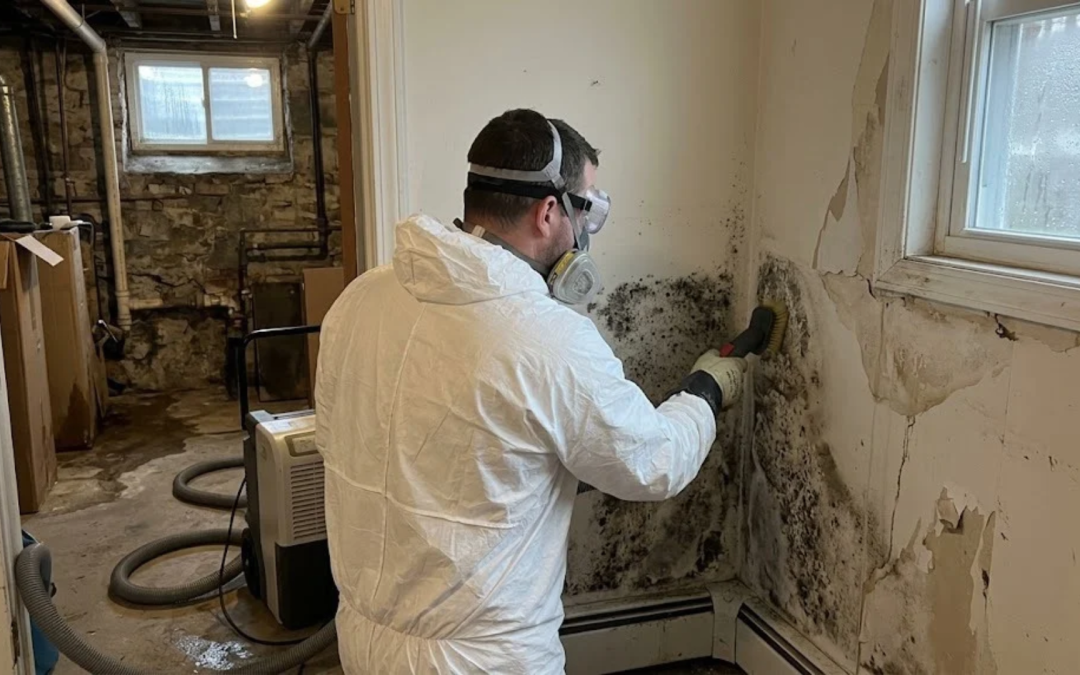
Certified remediation companies follow strict industry protocols—such as the Institute of Inspection, Cleaning and Restoration Certification (IICRC) S520 standard—to eradicate infestations without contaminating the rest of the dwelling.
-
Moisture Assessment and Thermal Mapping: Technicians deploy non-invasive infrared imaging cameras and pinless moisture meters to pinpoint the underlying origin of dampness behind finished walls.
-
Physical Containment and Negative Air Pressure: The contaminated work area is sealed off using heavy 6-mil flame-retardant poly sheeting and negative-air HEPA scrubbers, preventing spores from traveling into adjoining rooms.
-
Controlled Demolition of Non-Salvageable Porous Goods: Water-saturated drywall, blown-in insulation, and mold-compromised carpet are removed, bagged inside the containment zone, and discarded safely.
-
Structural Cleaning and HEPA Vacuuming: Remaining structural timbers and masonry elements are treated with commercial antimicrobial washes, hand-scrubbed, and meticulously vacuumed using certified HEPA equipment.
-
Post-Remediation Clearance Verification: Professional air quality sampling confirms that ambient indoor spore levels have returned to normal, healthy baselines.
Proactive Prevention: How to Protect Your Cranford Home Year-Round
-
Maintain indoor relative humidity levels between 30 and 50 percent year-round by running commercial-grade dehumidifiers in all below-grade basements and crawl spaces.
-
Equip the basement sump pump basin with an auxiliary dual-battery backup system to maintain pumping operation through seasonal thunderstorm power outages.
-
Direct exterior roof runoff away from the home by cleaning gutter lines and extending downspout discharge elbows at least six feet away from foundation walls.
-
Inspect roof flashings, chimney masonry caps, and window drip edges annually to intercept wind-driven rain intrusion before it penetrates the interior framing.
Understanding Mold Removal Costs & Homeowner Insurance in NJ
Remediation expenses vary significantly based on square footage and accessibility. In addition, the structural depth of the contamination plays a major role. For example, local remediation costs typically range from $1,500 to $3,500 for isolated attic or bathroom spaces. In contrast, pricing scales much higher for extensive, multi-room basement sanitization and structural drying.
Furthermore, insurance coverage depends on the specific cause of the moisture. In general, standard homeowners policies in New Jersey rarely cover damage from long-term deferred maintenance. Similarly, claims related to chronic foundation seepage or ambient indoor humidity are usually excluded. However, remediation costs may qualify for coverage in specific cases. For instance, policies often approve claims when mold stems directly from a sudden and accidental peril, such as a burst pipe or an abrupt appliance line break.
Schedule a Professional Mold Assessment in Cranford Today
Microscopic mold colonies multiply within just 48 hours of initial moisture contact. As a result, hesitation often turns a minor issue into a major structural headache.
Moreover, danger increases if your property has sustained recent stormwater inundation or plumbing leaks. Similarly, persistent musty odors serve as a clear warning sign. Consequently, prompt professional intervention is critical.
Therefore, you should contact a certified local mold remediation specialist in Union County today. First, they will perform a thorough inspection. Next, they will identify the underlying moisture driver. Ultimately, this proactive step will safeguard both your indoor air quality and your home’s structural integrity.
Protect Your Home Before Spores Spread!
Other Blog Post: